
Several days of steady rain can leave an old Beverly basement damp at the edges and puddled in the middle, even when no pipe has failed. In a house on a fieldstone, granite or brick foundation, the first day decides how far that water spreads into stored belongings and wall framing.
Key takeaways
- Seepage shows up along the base of the wall and the floor edge, while a plumbing leak sits near a pipe, tank or fixture.
- Soil over shallow ledge drains slowly, so the ground beside the foundation can stay saturated for days after the rain stops.
- Raise belongings off the floor, and stay out of standing water until the power to the basement is off.
- Extraction comes first. Dehumidifiers and air movers then dry the masonry, sill and joists to readings, not to a calendar.
- Water that returns after every storm points to a drainage problem that drying alone does not fix.
Why older foundations let water through
Many houses downtown and in the older neighborhoods date to the nineteenth century and the early twentieth. Their foundations are fieldstone, granite or brick, built long before modern waterproofing existed.
Those walls shed water slowly at best. Glacial till over shallow ledge drains poorly, and near the harbor the water table sits high, so the soil outside stays heavy long after the sky clears.
Where the water usually gets in
Seepage rarely comes as a jet. It creeps in, and it follows the same weak spots every time.
- Mortar joints in the lower part of the wall
- The joint where the wall meets the floor
- Old openings such as coal chutes, window wells and pipe penetrations
- Dirt or thin concrete floors that darken from below
Why a long rain is harder on a wall than a hard shower
A short downpour mostly runs off the yard. Days of steady rain soak the ground, and the water pressing on the wall has nowhere to go except through it.
Snowmelt after a cold spell does the same thing, which is why the problem often repeats in late winter.
Seepage or a plumbing leak?
Sorting out the source comes before anything else, because the cleanup and the repair are different jobs.
- Seepage: dampness starts at the floor edge, follows the weather and slowly eases once the rain stops.
- Supply leak: water collects near a pipe, water heater or fixture and keeps coming in dry weather.
- Heating leak: water around a boiler or radiator pipe, mostly in the cold months.
- Drain or sewage backup: dark or gray water, a sour smell, or water rising at a floor drain.
When the water looks dark
Dark water or a sewage smell means the water is contaminated. Keep out of it, because it is handled as a different category of cleanup from rain seepage.
Safe first steps in the basement
A wet basement hides hazards, mostly electrical. The owner can take a few steps in order and stop if anything feels unsafe.
Do right away
- If the electrical panel is dry and easy to reach, shut off the basement circuits before stepping into water. If the panel sits in the wet area, stay out and call the utility or an electrician.
- Lift boxes, rugs and furniture onto shelves or blocks.
- Photograph the high-water mark on walls and belongings before anything moves.
- Do not use a household vacuum on standing water.
Leave for the crew
- Soaked insulation, carpet and pad
- Wet drywall and trim at the bottom of finished walls
- Damp cardboard that may be hiding more water
- Any heavy item that takes two people to lift
What extraction removes first
Standing water comes out before anything else. Truck-mounted or portable extractors pull it from the floor, and wet carpet and pad are lifted so the extractor can reach the slab beneath.
The steps are laid out under water extraction and removal.
Extraction matters because water left in place keeps wicking into the sill plate, the lower joists and the stored boxes.
- Water pumped or vacuumed from low spots and corners
- Carpet and pad lifted and removed when saturated
- Silt and debris cleared from the floor
- Furniture and boxes moved so the whole floor can be reached
Drying stone walls and floor framing
Stone and brick hold water far longer than they look. A wall can feel dry on the surface while the inside of the masonry is still wet.
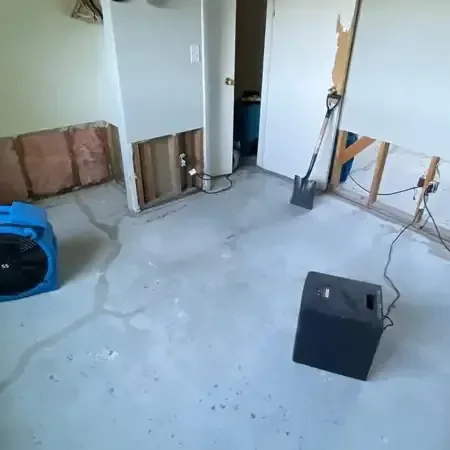
That is why moisture meters, not eyesight, decide when the equipment leaves. Structural drying runs dehumidifiers and air movers until the masonry, the wood sill and the joists all read dry.
What gets measured
- Readings on masonry, sill plate, joists and any subfloor above
- Humidity in the room, tracked at every visit
- Wet drywall and insulation, which are cut out rather than dried
Why timing matters
Mold can begin to grow in 24 to 48 hours on damp wood and paper, so wet materials should not sit.
Daily readings show whether the equipment is working or needs to be moved to a slower spot. The crew logs them, so the owner and the insurer can see the structure moving toward dry.
When the same water keeps coming back
Cleanup removes the water that came in. It does not change how the ground drains, and old stone walls will keep letting some water through in a wet season.
A basement that wets after every long rain deserves a look at the pump, the pit and the yard. A pit that overflows is a pump problem, covered under sump pump failure cleanup.
- Gutters and downspouts that empty beside the foundation
- Soil that slopes toward the house
- A sump pit that is missing, undersized or not running
- Cracks and old openings that were never sealed
What to tell the crew and the insurer
A short, honest account helps the crew plan the job. Say when the water was first noticed, whether it came back after drying out, and whether the basement has flooded before.
Keep the photographs, a list of damaged items and every moisture reading. The full scope is described under basement flooding cleanup.
- When the water appeared and where it entered
- Which items sat on the floor
- Whether a pump or drain was running
- Whether the water smelled or looked dark
Questions
Is a damp fieldstone basement normal?
Some dampness is common in foundations this old. Standing water, a wet floor edge or stained boxes mean water is getting in faster than the wall can shed it.
Can a dehumidifier alone dry a basement that took in water?
A household dehumidifier helps with humidity but cannot pull water out of masonry, framing and subfloor. Standing water needs extraction first, then equipment sized to the wet area.
How can basement water be told apart from sewage?
Dark or gray water, a sour smell and water coming up through a floor drain or toilet point to sewage. Stay out of it and treat it as contaminated.
Does homeowners insurance cover seepage after a long rain?
It depends on the policy and the cause. Many policies treat a sudden event differently from slow seepage through a wall, so read the wording or ask the insurer, and keep photographs and readings.
What should be thrown out after a basement takes in water?
Porous items such as carpet pad, wet insulation and soaked cardboard usually go. Hard items such as plastic bins and metal tools can often be cleaned and dried.