Water Extraction in Beverly, MA
The extraction crew pulls standing water off floors, out of carpet pad and up from basement slabs across Beverly with truck-mounted units, so the drying starts with as little water as possible. Crews roll 24/7.
(888) 629-3140Pull the standing water out first- Truck-mounted extraction
- IICRC S500 drying plan
- Moisture map on day one
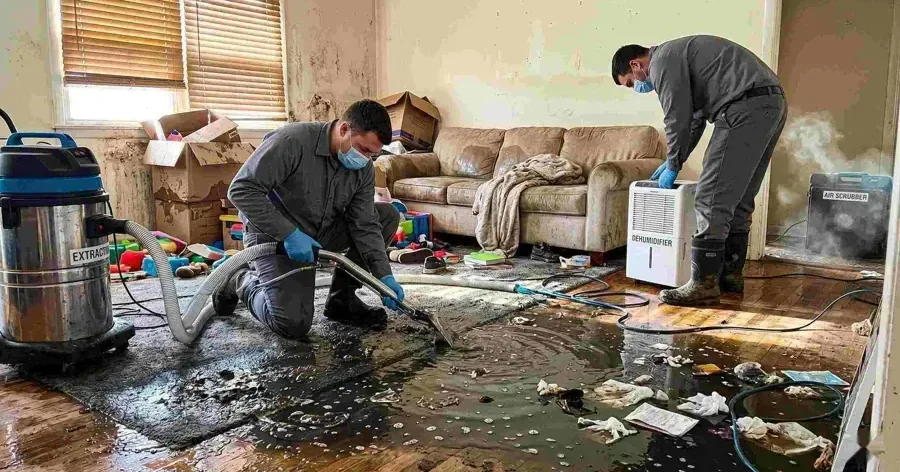
What to do first about water extraction and removal
- 1
Stop the source
Close the main valve or the fixture shutoff before anything else.
- 2
Kill the power
Switch off circuits to wet rooms if the panel is dry.
- 3
Save the contents
Move rugs, boxes and electronics to a dry floor.
- 4
Document it
Photograph every wet room before the crew arrives.
How water extraction and removal is handled, step by step
Each step follows the IICRC S500 drying standard, and the right-hand column is the record that step leaves in the claim file.
- 01MapMeters and thermal imaging trace the edge of the water.Moisture map with the category and class
- 02ExtractTruck-mounted units pull water from carpet, pad and floors.Timestamped photos before anything is removed
- 03DryAir movers and LGR dehumidifiers set to each room's load.Daily psychrometric and moisture log
- 04VerifyDaily readings until materials hit the dry reference.Final readings against a dry reference
What does water extraction and removal cost in Beverly, MA?
Water extraction here usually runs $600 to $7,000, and most jobs roll straight into drying. The water category, the square footage that got wet, the material class and how fast drying started move the number most.
Small area, clean water
$600 to $1,500
- One room or hallway
- Portable or truck unit
- Moisture map included
Several rooms
$1,500 to $3,500
- Carpet and pad work
- Truck-mounted extraction
- Daily readings start
Whole floor or basement
$3,500 to $7,000
- Large-area extraction
- Pad and baseboard removal
- Full drying setup
These are typical ranges, never a quote. The category of water, the square footage, the material class and how fast drying started move the number most. The water damage cost calculator gives a closer planning range.
Extraction is the cheapest drying there is. A truck-mounted unit removes more water from carpet and pad in an hour than air movers evaporate in a day, so the extraction crew pulls every gallon it can before a fan goes down. In older homes here, that water is usually headed for plaster, wide-board floors or a stone basement.
How extraction works in an old North Shore house
The walkthrough tech finds the source, sets the water category and maps how far it traveled with pinless meters and a thermal camera. Water runs under baseboards, along floor joists and down through ceiling plaster farther than it looks.
- Truck-mounted extraction for carpet, pad and large floors
- Portable units for upper floors and narrow stairways
- Weighted tools that squeeze water out of carpet pad
- Squeegees and wet vacuums on tile, vinyl and basement concrete
Carpet, pad, hardwood and plaster
With clean water caught early, carpet can often be floated and dried in place, while soaked pad usually comes out because it is cheap to replace and slow to dry. Old hardwood gets a panel drying system that pulls water up through the boards, and plaster on wood lath is read daily because it holds water longer than drywall.
Water still pooling on the floor? Each hour pushes it deeper into pad and plaster.
Get the truck-mounted unit rollingAfter the water is out
The drying team sets air movers to each room's evaporation load and adds LGR dehumidifiers. Readings run daily until materials reach the drying goal laid out under structural drying. If the water came from a split pipe, a plumber repairs the source while the drying runs, and the drying time estimator gives a rough schedule.
Skip the shop vacuum on deep water
A household or shop vacuum is not built for standing water near live outlets. If the panel is dry and safe to reach, switch off power to the wet rooms before anyone walks in.
Water extraction and removal across Beverly and nearby
The restoration team covers ZIP 01915 end to end, from Downtown, Goat Hill and the Cove to Montserrat, Centerville, Ryal Side and the north side, out along Hale Street to the Farms and Prides Crossing.
Nearby work reaches Danvers, Salem, Peabody, Wenham, Hamilton, Manchester-by-the-Sea, Marblehead and Lynn.
Related water damage services
Water Extraction and Removal questions, answered
What owners ask most about water extraction and removal, from drying time to the claim file.
Ask the drying team by phoneHow fast should water extraction start?
As soon as possible. Water keeps wicking into pad, drywall, plaster and framing every hour it sits, and clean water can turn into Category 2 within a day or two. Crews are dispatched 24/7.
Can wet carpet be saved after extraction?
Often, if the water was clean and extraction started early. The pad usually comes out, while the carpet is floated, dried and cleaned. Carpet touched by sewage or storm water is removed.
Does water extraction include drying?
Extraction removes the liquid; drying removes the moisture left in the materials. A complete job uses both, with air movers and dehumidifiers running until readings hit the drying goal.
Will the floors be dry right after extraction?
No. Extraction removes most of the free water, but subfloor, framing and plaster still hold moisture, so drying equipment and daily readings follow.
What equipment does water extraction use?
Truck-mounted extractors for large areas, portable units for upper floors, weighted carpet tools, squeegees and wet vacuums, plus moisture meters and thermal cameras to find the edge of the water.
Is water extraction covered by insurance?
Extraction after a sudden and accidental discharge is often part of a covered claim, while surface flooding usually needs flood coverage. Coverage depends on your policy, so check it with your own insurer.
Standing water in the house? Have it pulled out before it wicks.
The extraction crew removes the water first, then the drying team takes over with daily readings. Dispatch runs 24/7.