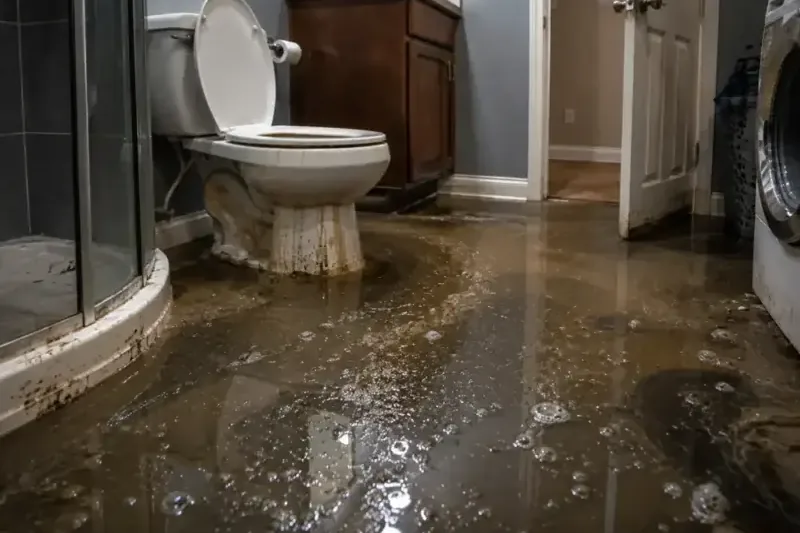
Older Lynn sewers carry rainwater runoff, household sewage and industrial wastewater in the same pipe. When a heavy storm fills that pipe, the water looks for the nearest way out, and sometimes the nearest way out is a basement drain.
Key takeaways
- Older sewers here are a combined system with 5 overflows that discharge excess flow in heavy rain or snowmelt.
- NBC10 Boston reported that residents west of Commercial Street to the Saugus River had complained of backups for years.
- A September 2017 account described dark water rising through a toilet and sink in a finished basement, where walls had to be opened.
- The $120 million separation project finished in April 2026 is a milestone, but it does not tell any one owner whether a drain is safe.
- Sewage water is Category 3: no wading, no household vacuum, and porous materials come out.
What a combined sewer is
A combined sewer carries rain runoff and household wastewater in one pipe. In dry weather that works.
In a hard rain the pipe fills fast.
The Lynn Water and Sewer Commission runs the system, and its older sewers are combined. The system has 5 combined sewer overflows, which discharge excess flow during heavy rain or snowmelt so it does not back up into homes, businesses and streets.
- Two overflows relieve downtown sewers into the harbor next to Heritage State Park
- One sits at Summer Street beside the Strawberry Brook Culvert
- Two discharge to the Stacey Brook Stormwater Conduit, which ends at King's Beach
- The commission emails an advisory to people who sign up when an overflow happens
How heavy rain pushes water into a basement
When the pipe cannot carry the flow, water finds the lowest opening in a building. That is usually a basement floor drain, a basement toilet, a laundry sink or a shower.
The risk is highest early in a storm, when street drains fill and the pipe runs full. Snowmelt can do the same thing when rain falls on a thaw.
The area has seen intense rain more than once. On September 30, 2017, more than 3 inches fell in less than 2 hours, and on September 18, 2018, remnants of Hurricane Florence flooded the Lynnway.
What a homeowner described
In September 2017 a homeowner on a quiet street near the Saugus River reported dark water rising through the toilet and sink of a finished basement. Walls had to be opened.
In January 2018 an NBC10 Boston investigation called the sewer system, more than a century old, a possible contributor to sewage backups into homes and streets.
Backup from the main or a problem in the private pipe?
Not every sewage backup comes from the street. A clog in the private pipe can look the same from inside the house.
A plumber or the commission can say which it is. Who owns which section of pipe is a question for them, not a guess.
The difference changes who fixes the problem, but it does not change the cleanup. Sewage on a basement floor is handled the same way whichever pipe it came from.
- Several fixtures backing up at once points to the main or a shared pipe
- One fixture backing up points to a clog in a branch
- Neighbors with the same problem point to the street
- A backup during a storm points to the system, not a clog
Why sewage water is Category 3
Sewage carries bacteria and other contaminants. The trade classes it as Category 3 water from the start, whatever it looks like once diluted.
That changes what is safe to do. The owner should not wade in, run a household vacuum or try to save porous items.
Even a small amount matters. A film of sewage on a floor can spread on boots, paws and wet hands to rooms that were never wet, so keeping everyone out of the area is part of the cleanup.
- Keep children, pets and visitors out of the basement
- Stop using sinks, tubs and toilets that drain to the basement
- Do not touch the water without protective gear
- Set aside, do not scrub, the items the water reached
What the cleanup removes and how it is dried
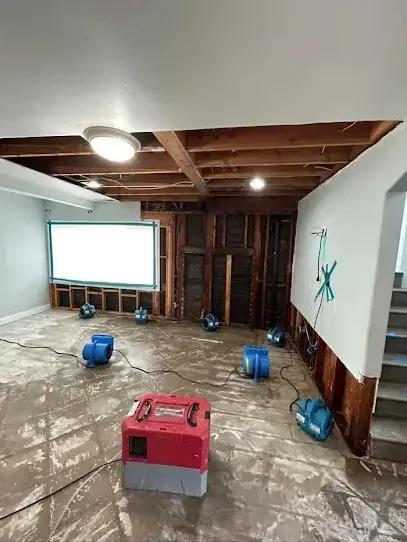
The crew wears protective gear and starts by extracting the water. Porous materials come out, because they cannot be made reliably clean.
The steps are listed under sewage backup cleanup, and the related work for the lower level is described under basement flooding cleanup.
What comes out
- Carpet, pad and rugs
- Insulation and drywall at the wet base
- Cabinet kicks, trim and particleboard
- Cardboard, paper and fabric stored on the floor
What stays and gets cleaned
- Concrete, block and masonry walls
- Solid wood framing and sills
- Metal fixtures and hard storage bins
- Pipes and hard surfaces treated with antimicrobial
Reading the $120 million separation project
In April 2026 the commission completed a $120 million project that separated stormwater and sewer systems in West Lynn. It separated about 260 acres of combined pipes and added a stormwater pump station.
East Lynn was separated more than two decades earlier.
That is real progress, but it is not a promise about any one house. A backup can still come from a blockage or a private pipe, and the readings in a wet basement still need to be taken.
- Separated pipes reduce the load on the old sewers
- A private pipe or a blockage can still cause a backup
- Owners should still watch floor drains in heavy rain
- A plumber can say whether a backwater valve makes sense
After the cleanup: records and next steps
Photographs, a list of discarded items and the daily moisture logs all belong in one folder. Many homeowners policies treat sewer backup as an add-on, so the insurer should be asked early which coverage applies.
The sewage cleanup page for the wider area shows how a typical job file looks.
- Keep dated photographs of the water and the damage
- Save receipts for cleaning and temporary housing
- Ask the insurer in writing about sewer backup coverage
- Have a plumber check the private pipe before the next storm
Questions
Why does sewage back up into Lynn basements?
Older sewers here are combined, carrying rain runoff and household sewage together. In a hard rain the pipe can fill and push water into the lowest drain in a building.
Is it sewage if the water is clear?
Not always, but any water that came up through a floor drain or toilet should be treated as sewage until a professional says otherwise.
Is the West Lynn project the end of backups?
No promise can be made. The project separated stormwater and sewer pipes in the western part of the city, but backups can still come from a blockage or a private pipe.
Can wet drywall and carpet be saved after a sewage backup?
Usually not. Carpet, pad, insulation and drywall that sewage touched are removed because they cannot be reliably cleaned.
Does the commission warn people about overflows?
It emails a public advisory to people who sign up when an overflow happens, repeats it every 8 hours and sends an end notice.
Who should be called first?
Keep people away from the water, then call the restoration crew and a plumber. Report the problem to the commission if neighbors see the same thing.