Burst Pipe Water Damage in Peabody, MA
A burst supply pipe can release a large volume of water in a short time, and it soaks floors, walls and ceilings before anyone can reach the shutoff. Cleanup removes the water and maps what is still wet.
(888) 629-3140Trace a burst pipe leak- Supply leaks traced
- Wet framing mapped
- Rooms dried out
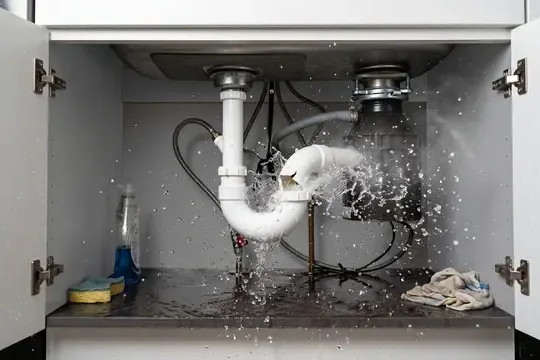
What to do first about burst pipe water damage
- 1
Close the shutoff
Water to the broken pipe is stopped.
- 2
Remove the water
Pumps and extractors clear every wet level.
- 3
Map the damage
Meters trace water through walls and floors.
- 4
Open and dry
Wet materials come out and equipment is placed.
How burst pipe water damage is handled, step by step
Each step follows the IICRC S500 drying standard, and the right-hand column is the record that step leaves in the claim file.
- 01TraceMeters and a thermal camera follow the leak path.Moisture map with the category and class
- 02ExtractStanding water is removed from floors and carpet.Timestamped photos before anything is removed
- 03OpenWet drywall and insulation are cut back when needed.Daily psychrometric and moisture log
- 04DryEquipment runs until each material reads normal.Final readings against a dry reference
What does burst pipe water damage cost in Peabody, MA?
Burst pipe cost tracks how many rooms got wet and how long the leak ran before the water was stopped. A hidden failure costs the most because it soaks framing, ceilings and subfloors for weeks.
Pinhole, one room
$1,500 to $3,000
- One wet room
- Small repair opening
- Short drying run
Burst, several rooms
$3,000 to $7,000
- Walls and ceilings wet
- Floors extracted
- Equipment in each room
Hidden for weeks
$7,000 to $10,000+
- Framing and subfloor wet
- Heavy material removal
- Extended drying
These are typical ranges, never a quote. The category of water, the square footage, the material class and how fast drying started move the number most. The water damage cost calculator gives a closer planning range.
Supply pipes run under pressure, so a failure sends water out until the valve is closed. By the time it is noticed, a burst can have wet an entire wall, the ceiling below and the floor beneath it. The cleanup goal is to find every wet surface, not only the visible one.
What a burst pipe does to a building
Water moves down through floor cavities, along joists and into any wall it can reach. Drywall wicks it upward, insulation holds it, and hardwood or laminate floors cup as they absorb moisture. Each material dries at its own pace, which is why meters direct the work.
- Water supply closed at the valve nearest the leak
- Standing water extracted from every affected level
- Wet drywall and insulation removed when needed
- Air movers and dehumidifiers placed by meter readings
Hidden leaks and slow failures
Not every burst is dramatic. A pinhole or a weeping joint can soak a wall for weeks, leaving stained drywall, a musty smell or a spongy floor as the first sign. Because the damage built up slowly, the work usually involves more material removal than a sudden burst stopped right away.
A pipe that has burst keeps releasing water until the supply is closed, so shutting it off and calling should happen together.
Reach the leak crewHousing age and where leaks start
With a median build year near 1966 and about half of housing units not single family detached, a burst in one unit can reach the home below.
Know the shutoff
Every household member should know where the shutoff valve is and how to close it, because closing it early decides how many rooms get wet.
Burst pipe water damage across Peabody and nearby
Burst pipe calls cover ZIP codes 01960 and 01961, with work in downtown, the Central Street corridor, the Proctor neighborhood, South Peabody, West Peabody and the streets around Centennial Park.
The same service nearby: burst pipe water damage in Beverly, Danvers, Lynn.
Related water damage services
Burst Pipe Water Damage questions, answered
What owners ask most about burst pipe water damage, from drying time to the claim file.
Ask the drying team by phoneWhere should the water be shut off?
At the valve nearest the broken pipe if it can be reached, or at the main shutoff for the house. Closing it early limits how many rooms get wet before extraction starts.
Does a burst always mean tearing out walls?
No. If the leak was caught early and the drywall is only damp, meters may show it can dry in place. Walls that stayed wet for days or hold insulation soaked through usually need to be opened.
Who repairs the pipe itself?
A plumber repairs or replaces the pipe, and the restoration crew handles water extraction, drying and wet materials. The two jobs can run at the same time once the supply is off.
What if the burst is in an upstairs unit?
Water drops through floors and light fixtures into the unit below, so both spaces are checked. Ceilings that bulge hold trapped water and are opened carefully, as described on the ceiling leak page.
How is a hidden pipe leak found?
Moisture meters and thermal imaging read behind walls and under floors without cutting them open. Spots that stay cooler or wetter than their surroundings point to the leak path.
Can a burst pipe cause problems later?
Materials left wet can warp, stain and grow mold within 24 to 48 hours, so thorough drying matters even when the surface looks fine. Final meter readings confirm nothing is left behind.
Stop the water, then dry what it reached
Water removal and drying start together, with meters tracing the leak path through walls, ceilings and floors.