Structural Drying in Salem, MA
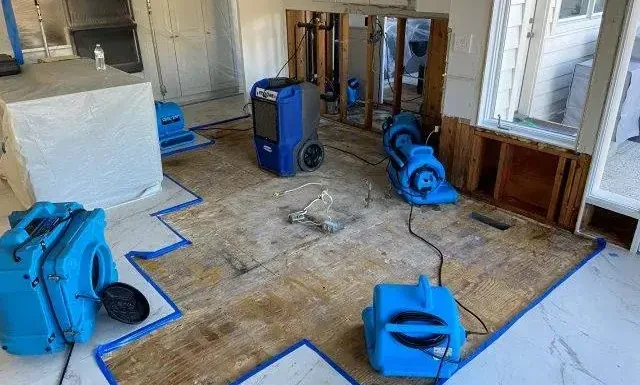
Brick, plaster and framing hold moisture long after the standing water is gone. Technicians map the wet materials, place air movers and dehumidifiers and keep reading meters until the structure tests dry.
(888) 629-3140Call about drying a building- Moisture mapped
- Equipment layout planned
- Daily readings logged
What to do first about structural drying and dehumidification
- 1
Map the moisture
Meters and a thermal camera mark every wet material.
- 2
Set the layout
Air movers and dehumidifiers go where the readings call for them.
- 3
Check each visit
Readings are taken and equipment is adjusted.
- 4
Confirm dry
Final readings are compared with dry samples.
How structural drying and dehumidification is handled, step by step
Each step follows the IICRC S500 drying standard, and the right-hand column is the record that step leaves in the claim file.
- 01MeasureMoisture content is logged for each material.Moisture map with the category and class
- 02PlaceEquipment is matched to the layout and materials.Timestamped photos before anything is removed
- 03MonitorDaily readings drive changes to the setup.Daily psychrometric and moisture log
- 04ReleaseEquipment leaves when the dry standard is met.Final readings against a dry reference
What does structural drying and dehumidification cost in Salem, MA?
Drying one room in Class 1 or 2 conditions starts near $1,000, and dense Class 4 materials such as masonry can pass $8,000. Material type and room count set the figure, confirmed after the first readings.
Class 1 or 2, one room
$1,000 to $2,500
- One room wet
- Standard equipment
- Short drying
Several rooms
$2,500 to $5,000
- Rooms on a floor
- More air movers
- Days of readings
Class 4 materials
$5,000 to $8,000+
- Masonry or hardwood
- Specialty equipment
- Longer drying
These are typical ranges, never a quote. The category of water, the square footage, the material class and how fast drying started move the number most. The water damage cost calculator gives a closer planning range.
Drying a structure is closer to engineering than to running fans. Each material takes in and gives off water at its own pace, so the equipment layout and the readings have to follow the building, not a schedule.
Brick, plaster and shared walls
The Point was rebuilt after 1914 in brick and masonry as apartment buildings, row houses and larger buildings, and downtown carries brick and granite blocks. Those walls are shared, dense and slow to dry, so equipment has to reach into party walls, floor framing and the spaces above and below a wet unit.
- Dense masonry and plaster dry more slowly than drywall.
- Hardwood and old framing need gentle, controlled drying.
- Shared walls carry moisture to neighboring units.
- Heat and humidity levels are logged at every visit.
How the equipment is set
Air movers push dry air across wet surfaces while dehumidifiers pull the moisture out of the room, and extra gear can reach inside wall cavities. Technicians adjust the layout as readings change and remove equipment only when the final reading matches a dry sample. Extraction usually comes first; see water extraction for that stage.
Water gone but walls still damp? Call to review the readings and set up a drying layout.
Salem drying helpWhy readings beat guesses
Two walls that feel equally dry can hold very different amounts of moisture, which is why crews trust meters over touch. Logging each reading also gives the adjuster proof of the process.
Close the windows
Open windows let outside humidity back in, so keep the space closed while dehumidifiers run.
Structural drying and dehumidification across Salem and nearby
Structural drying covers 01970, including brick apartment buildings on The Point, downtown blocks, Federal period homes in the McIntire District and Derby Street, and mid century homes near Highland Avenue.
The same service nearby: structural drying and dehumidification in Beverly, Lynn, Peabody.
Related water damage services
Structural Drying and Dehumidification questions, answered
What owners ask most about structural drying and dehumidification, from drying time to the claim file.
Ask the drying team by phoneHow do you know when a building is dry?
A meter reading on each material is compared with a dry sample from the same building. Appearance and touch are not enough, which is why readings are logged.
Why can dry walls still hold moisture?
Dense materials such as brick and plaster hold water deep inside and release it slowly. Surface checks can look fine while the core is still wet.
Can floors and framing be dried without removal?
Often yes if the water was clean and caught early. Controlled airflow and dehumidifiers pull moisture out of wood, though contaminated water changes that plan.
Is drying the same in every season?
No. Cold dry air and warm humid air behave differently, so crews adjust equipment and watch humidity so drying does not stall.
Do I have to keep the windows closed?
Yes, during active drying. A closed space lets dehumidifiers do their work, and open windows can let humid air back in during damp weather.
Is drying done the same way nearby?
The Beverly structural drying page explains the drying method as used for the neighboring city.
Dry means measured dry
Tell the crew which materials got wet, and a layout can be planned with readings from the first visit.